
Floor-to-Ceiling Stone Fireplace Cost in 2026: A Real Project Breakdown
A floor-to-ceiling stone fireplace in the Carolinas typically runs $7,500 to $15,000, installed. Height is the biggest single factor: a standard 9–10 foot ceiling sits at the low end, while a two-story great room needs scaffolding, more stone and more days on site. Our most recent 21-foot build came to $14,650.
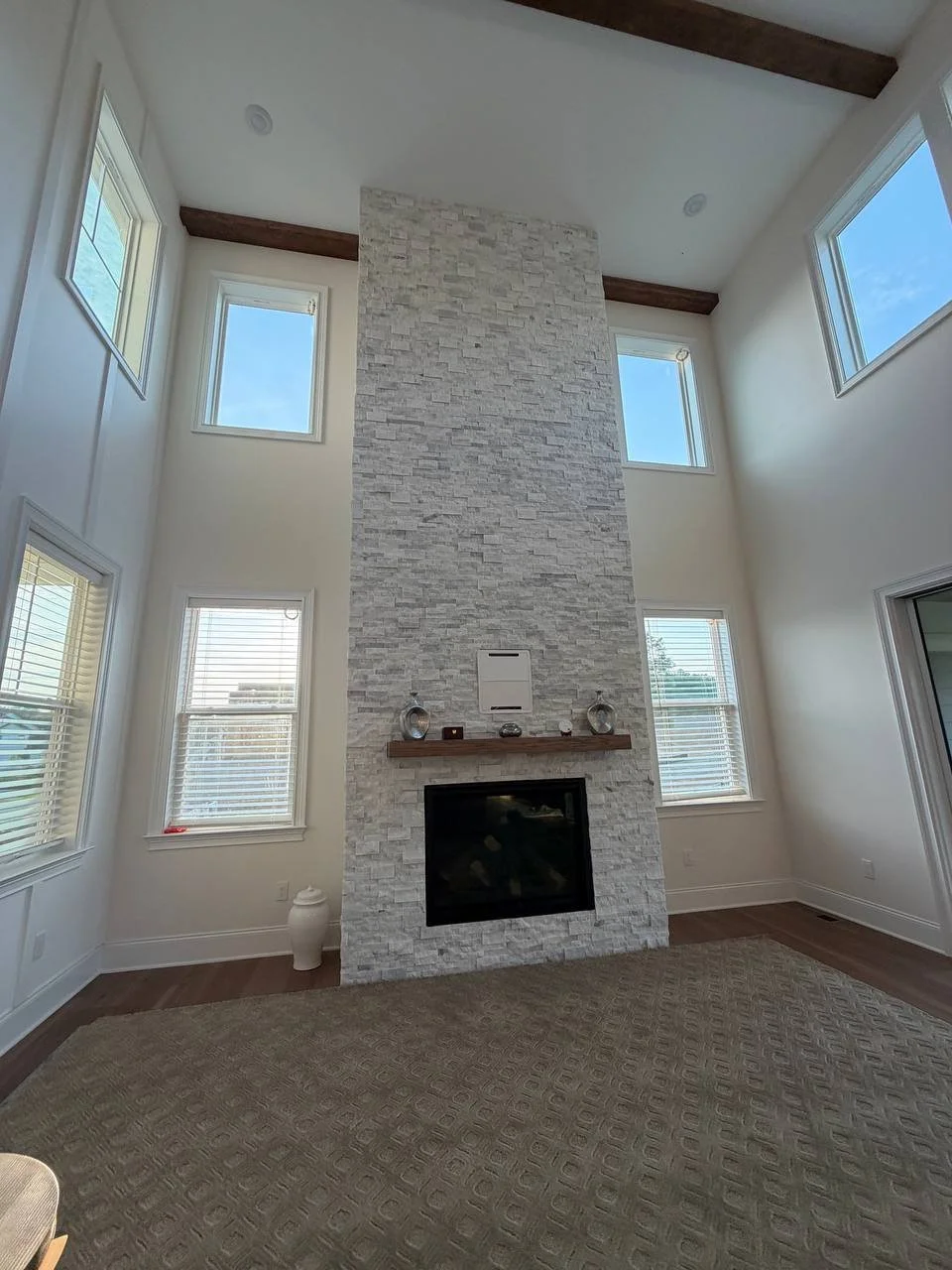
A real project: 21 feet of stone for $14,650
Most articles about fireplace cost quote a national average and leave it there. This one is a single job we finished, with the photos and the invoice total.
The house is in the Raleigh, North Carolina area. A two-story great room with exposed beams, a wall of windows on both levels, and a chimney breast running the full 21 feet from floor to ceiling. The gas firebox and the framed structure were already in place and working. What the homeowners no longer wanted was the tile on the lower section.
This is worth being precise about, because it is the most common version of this job. We did not build a fireplace. We re-clad one. The appliance was never touched.
We removed the existing tile and re-clad the entire 21-foot face in natural stone, top to bottom, returns included.
Total: $14,650. That covered the stone, all installation materials, delivery, scaffolding and labor.
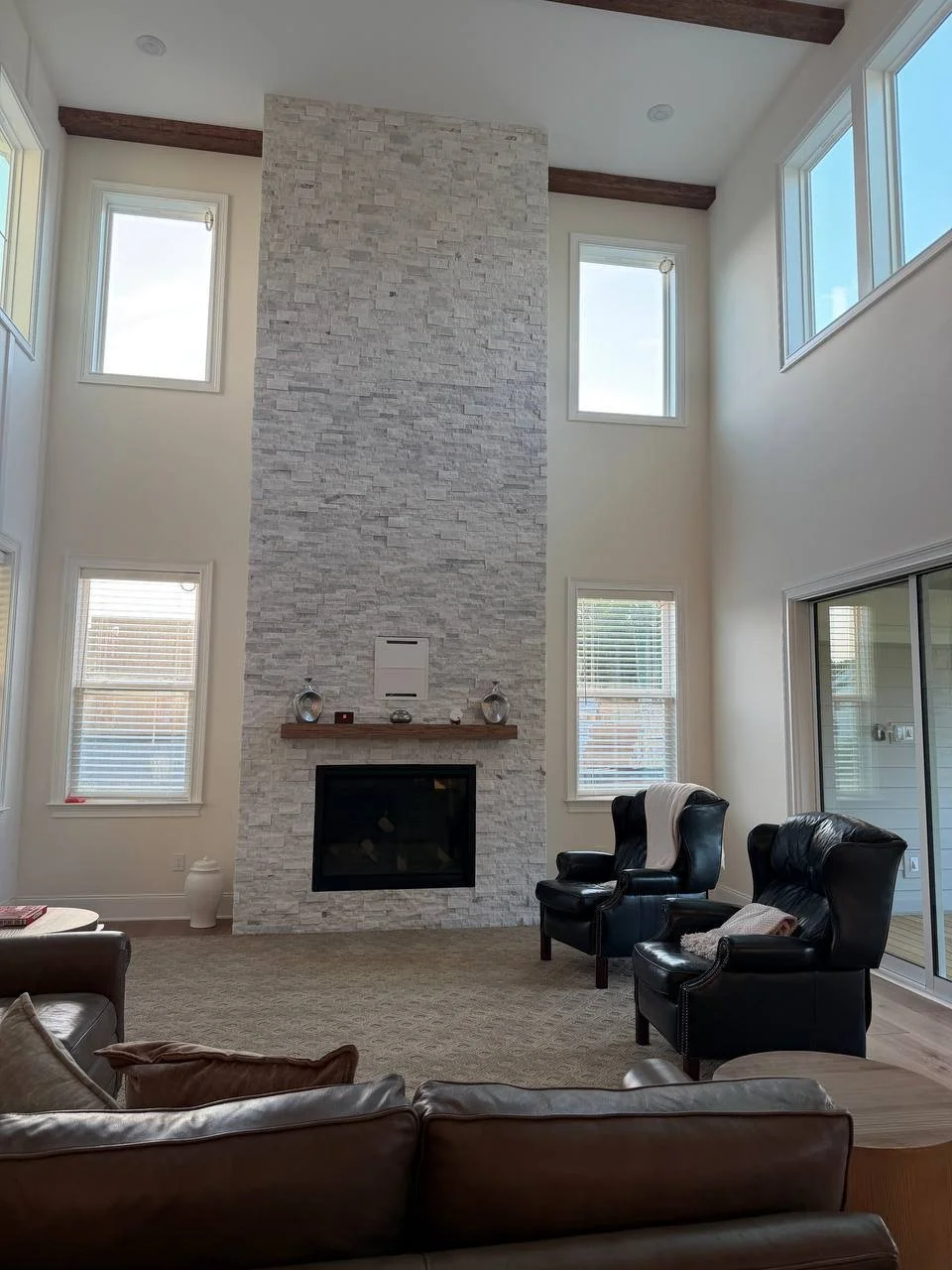
Why this one landed at $14,650
Three things pushed this above a standard build.
21 feet of vertical face. Roughly double the stone of a 10-foot wall, and every panel above head height is slower to set.
Scaffolding. At two stories you are renting, erecting, moving and striking scaffold inside a finished, furnished room. That is a real line item, not a rounding error.
Demolition and prep. The old tile had to come off cleanly without damaging the framing or the firebox surround underneath.
A build-out of this design at a normal ceiling height starts at $7,500 on our pricing page. The extra 11 feet is what the difference buys.
What the $14,650 included
| Item | What it covers |
|---|---|
| Stone | Natural marble split-faced ledger panels, full 21-foot face plus side returns |
| Materials | Mortar, backer, corner pieces, fasteners, sealant, prep and protection |
| Delivery | Stone freight to site and haul-away of the demolished tile |
| Scaffolding | Rental, setup, repositioning and removal inside a furnished room |
| Labor | Demolition, layout, cutting, setting, corners, mantel fit and final clean |
Not included: the firebox. The homeowners already had a working gas unit, and it stayed exactly as it was. We built the stone around it. That is a meaningful part of why this number is what it is, and why re-cladding an existing fireplace is often the better value. The expensive, permit-carrying part of the job was already done.
If a firebox is part of your scope, we price the unit separately so you are not paying for a model you did not choose. We install electric fireboxes, and the units themselves range from roughly $100 to $5,000 depending on size and features. We do not install gas appliances. See the FAQ below for how that works.
The stone we used
The homeowners chose Coastal Bluff Split Faced Marble Ledger Panel, a natural marble ledger panel in 6 inch by 24 inch sheets, currently around $7.99 per square foot at retail.
We like this stone and we recommend it often. It is genuine marble rather than a cast lookalike, the split face gives real shadow depth instead of a printed texture, it cuts and sets predictably, and it is not expensive. The pale grey and white blend also does something specific in a room like this. On a 21-foot wall, a dark stone can feel like a cliff. A light one keeps the height and gives it back to the room as brightness.
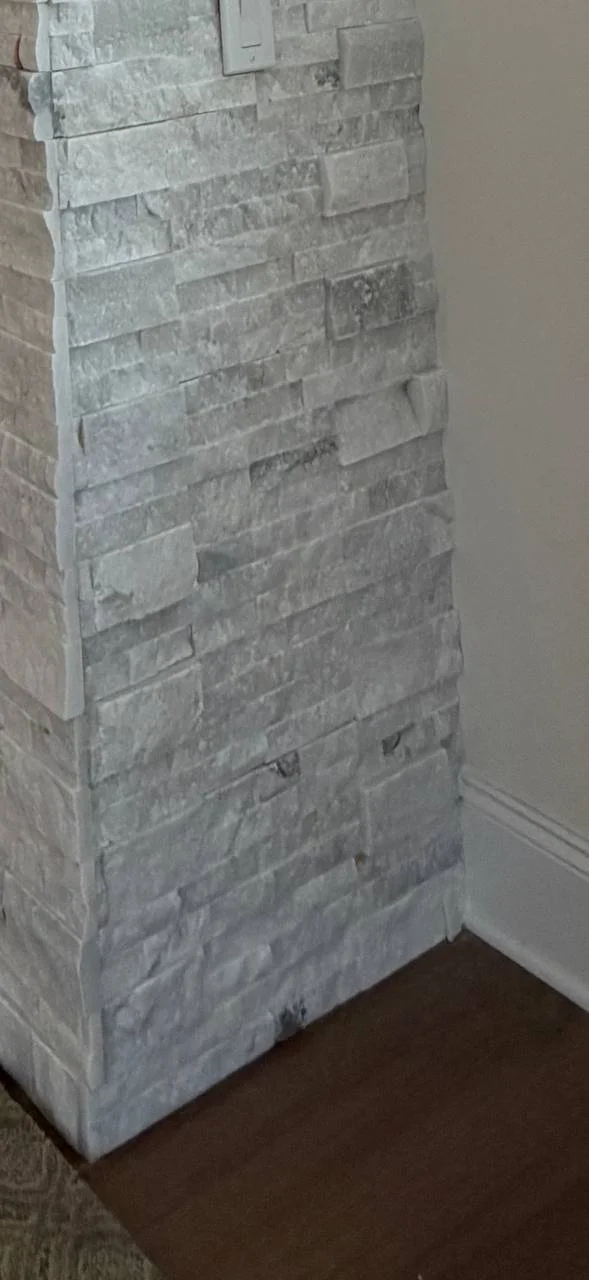
You can supply your own stone, and plenty of clients arrive with a slab yard or Floor & Decor pick already made. Or we will source and specify it as part of the quote.
Natural stone vs. manufactured stone veneer
Both are used on the walls we build, and neither is the automatic right answer.
Natural stone is quarried rock cut into panels. Every piece is different, the color runs through the material rather than sitting on the surface, and chips age into the stone instead of exposing a grey core. It is heavier, which matters for what the wall behind it has to carry, and it cuts more slowly.
Manufactured stone veneer is molded and pigmented, with gypsum-based products for interior work and concrete-based for exterior. It is lighter, faster to install, cheaper per square foot, and available in a much wider range of colors and profiles. The trade-off is repetition. Molds repeat, so a large wall can start to show the same rock three times if it is not laid out carefully. Manufactured stone can also be painted or limewashed, which natural stone generally should not be.
| Feature | Natural stone | Manufactured veneer |
|---|---|---|
| Material cost | Higher | Lower |
| Weight | Heavier | Lighter |
| Color variation | Every piece unique | Repeats by mold |
| Ages | Chips blend in | Chips can show core |
| Can be painted | Not recommended | Yes |
For a feature wall you will look at every day for twenty years, natural stone usually wins. For a large surface on a tight budget, or where the design calls for a color no quarry produces, manufactured veneer is a sound choice rather than a compromise.
How long a floor-to-ceiling stone fireplace takes
Standard 9 to 10 foot ceiling: 3 to 5 days
Two-story wall of 18 to 22 feet: 5 to 8 days
The gap is not the stone. It is the access. Every foot above about ten changes the job. Scaffold has to go up before any stone goes on, material gets carried up instead of set down, and cuts have to be dry-fit at height rather than on a bench. Add a day if there is demolition first, as there was on the Raleigh project.
Ceiling height in the Carolinas breaks down roughly like this. Older homes are commonly 8 feet, newer construction 9, premium builds 10 to 11, and the two-story great rooms that make these fireplaces so dramatic run 18 to 22 feet.
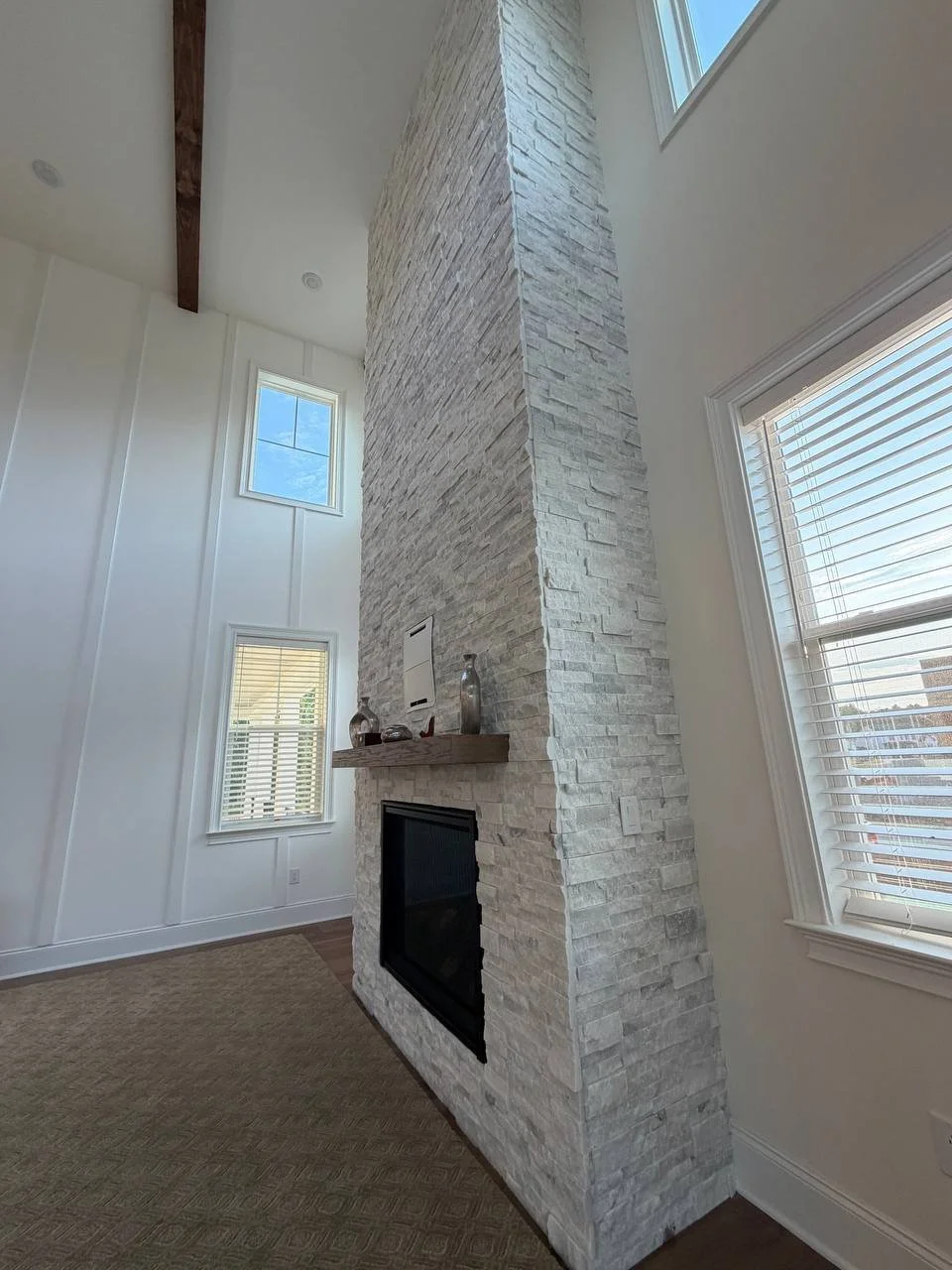
Dry stack vs. grouted: what changes
Dry stack, which is what you see in these photos, sets the panels tight against each other with no visible grout joint. Ledger panels are made for this. The result reads as a wall of stone rather than a wall of tile, and the shadow lines between courses do the visual work.
Grouted leaves a mortar joint between stones, and the joint color becomes a design decision of its own. Matched grout makes the wall read as one mass. Contrasting grout makes every stone a distinct shape. We install both, in a range of grout colors, and either can be the right call depending on the stone profile and the look you are after.
Cost difference between the two is minor on a job this size. It is an aesthetic choice, not a budget one.
What actually drives the price up
In rough order of impact:
Ceiling height. The single largest variable. Every additional foot adds stone, and past 10 feet it adds equipment.
Access and staging. A furnished, occupied room with hardwood to protect costs more to work in than a bare space in a new build.
Stone selection. Ledger panels are efficient. Irregular natural ledgestone, thin brick, or a large-format European style stone all take longer to set.
Demolition. Removing existing tile, brick or a builder-grade surround before anything new goes on.
The mantel. A floating stained wood mantel like this one is straightforward. Reclaimed timber, a stone shelf or a full mantel surround is not.
Firebox work. Swapping or adding a unit brings electrical or gas trades into the schedule.
Built-ins. Flanking cabinets and shelving move the job into a different pricing category, and often into TV media wall territory.

What it costs at a standard 9 to 10 foot ceiling
Here is the same design, scaled to a normal room.
Take a chimney breast 6 feet wide by 10 feet tall with 18 inch returns on each side. That is about 90 square feet of stone. At the $7.99 per square foot the Coastal Bluff panels run, plus the 10 percent overage you order for cuts and corners, the stone itself is roughly $790.
That number surprises people, and it is the most useful thing in this article. The stone is rarely the expensive part. Labor, prep, materials, protection, cutting, corner work, the mantel and the finish carry the rest of the number.
Builds of this type start at $7,500, which is our published starting point for a classic floor-to-ceiling build-out. Add flanking storage and shelving and you are into the $9,500+ category. Take the same wall to 21 feet and you are at the $14,650 we started this article with.
Different product, different math: a flat accent wall is priced per square foot, from $12 to $50 depending on the treatment.
Frequently asked questions
How much does a floor-to-ceiling stone fireplace cost? Between $7,500 and $15,000 installed for most homes in the Carolinas. Standard 9 to 10 foot ceilings sit near the bottom of that range, and two-story great rooms sit near the top. Our most recent 21-foot project in the Raleigh area was $14,650 including stone, materials, delivery, scaffolding and labor.
Is stone veneer cheaper than full stone? Yes, substantially. Full-thickness masonry stone needs a footing and structural support. Veneer, whether natural or manufactured, attaches to the framed wall, which is why nearly every interior floor-to-ceiling fireplace built today is veneer. The finished wall looks the same from the room.
Can you put stone over an existing brick or tile fireplace? Often, yes. The Raleigh project was exactly this: existing tile removed, stone installed over the same structure, gas unit left untouched. Whether the existing surface can stay or has to come off depends on what is behind it and how much depth the room can give up.
I have a gas fireplace. Can you still do this? Yes, and that is precisely what the Raleigh project was. We do not install or service gas appliances, and we do not need to. We build the stone, panels, mantels, shelving and TV integration around a working gas unit without touching the appliance, its venting or its gas line. If a gas unit needs to be added or replaced, that is a licensed gas contractor's work, and we schedule around them.
Do you install fireplace units at all? Electric ones, yes. Those we install ourselves, and the units run roughly $100 to $5,000 depending on the model. Gas, no.
How much does the stone itself cost? The natural marble ledger panels on this project run about $7.99 per square foot. A typical 10-foot chimney breast needs roughly 90 square feet, so the stone is usually under $1,000 on a job costing several times that. Labor and access are the cost.
Do I have to leave the house during installation? No. These are 3 to 8 day jobs and people live through them. We protect floors and furniture, contain dust and clean the site daily. On a two-story wall the scaffold does take over the room while it is up.
Do you serve the Raleigh area, or only Charlotte? Both. We are based in Charlotte and work throughout North Carolina and the Carolinas, including the Raleigh and Durham area.
Will a stone fireplace make the room darker? It depends entirely on the stone. The pale marble on this project reflects light and reads brighter than the tile it replaced. A dark ledgestone on a 20-foot wall is a genuinely different room.
Get a real number for your room
Ranges are useful for planning. They are not a quote. The difference between $7,500 and $15,000 on your wall comes down to your ceiling height, your stone, and what is on the wall right now.
Send us the room and we will give you a fixed price and a visualization of the finished wall before anything is ordered. Both are free.
Request your free quote and visualization
See more of our work: fireplace build-outs · TV media walls · pricing
